

Knowledge continuity · for the office that runs the shop
Your best people are retiring. Their know‑how doesn't have to.
We don't just install AI. Before that know‑how retires with them, we turn the pricing instincts, the fixes, the hard‑won judgment in their heads into a cookbook your business owns — and systems your whole crew can run on. The tools will change. The cookbook doesn’t retire. We stay on to keep it true.
or call 778‑985‑OPEN (6736)
The moment your business is in
The real work runs on what lives in two or three people's heads. And those heads are moving on.
The veteran who knows how a quote really comes together, which customer needs what, the pricing call nobody else can make — it's never been written down. Here's the part nobody likes to say out loud: a business that lives in a few people's heads is worth less the day you go to sell it. Buyers see the risk even when you don't. So do your best customers — the first time a job goes sideways after someone moves on.
This isn't a technology problem. It's a continuity problem — and it's fixable.
How we work
We work differently — on purpose.
The default — automation to cut headcount, AI as a sales pitch, delivered through tools you'll never own — leaves owners anxious and good people sidelined. That's not this.
People stay essential
Used well, modern tools make your people more capable, not less needed. We design systems that respect the judgment your team has earned.
Wisdom over speed
Wisdom is a slower technology than intelligence. We work at the pace good work needs, not the pace the hype cycle demands.
You own the cookbook
Everything we capture — how you quote, price, decide, and keep customers — goes into a written cookbook that belongs to your company, in plain language your next hire can follow. The systems we build from it are yours too, free of lock‑in and hosted where you want (Canadian end‑to‑end if that matters to you). But the cookbook is the asset: any tool, any time, anyone can cook from it. Software comes and goes. The cookbook stays on your shelf.
One person, accountable
The person you talk to is the person doing the work. No account managers, no pipelines, no chatbots between you and the help.
The work
Keep what they know. Then build it into the business.
Three steps: find out where you're exposed, fix it, and keep it handled. We work where the know‑how lives — quoting, pricing, orders, customer history — the office side that runs the place. Every engagement starts by understanding your actual problem before we suggest a thing.
The Continuity Audit
We spend a few focused hours with your team — the people who run the quotes, pricing, and orders — and find exactly where you're exposed: who holds what, what it would cost you if they left tomorrow, and what it's doing to the value of your business. You get a plain‑English risk report and a roadmap. Fixed fee. Nothing to install.
You walk away knowing where your business is exposed — and what to do about it.
How the audit works →Capture it — and make it usable
We sit down with your best people, draw out what's in their heads, and build it into systems the whole crew can actually use — documented, trained, and built to last. You don't need to clean up thirty years of spreadsheets first: that mess is the knowledge, and waiting for perfect data is how it gets lost. The modern tools do the heavy lifting so it's fast and affordable — but software records which buttons get pushed. We capture the judgment — the human part, the part that leaves with them when a veteran moves on — and write it into a cookbook your company owns. From there we build the tools your crew actually uses. Change platforms in five years? The cookbook comes with you and the new tools get built from the same book.
The day your best person retires, the work doesn't stop.
Your tools, kept running — and never falling behind
Think of it as a continuity partner on retainer. Each quarter we open your cookbook and check it against how the work really gets done now — what changed, what a new hire tripped on, what the next retirement will take with it — and we keep the tools built from it healthy, hosted and running (Canadian servers if that matters to your business), on a cadence that fits how hard you lean on them: quarterly, monthly, or weekly. When the next key person moves on, their chapter gets written too. You own the cookbook and everything built from it; walk away anytime and it all comes with you.
The system stays alive, current, and improving — with a partner who already knows how your business thinks.
Everything we build comes with full documentation and a handover session. Independence is built in — System Care is there when you'd rather have a partner on call.
Client results
What "build it into a system" actually looks like.
Real projects for real manufacturers — the before and after of taking knowledge that lived in a spreadsheet (and one person's head) and turning it into a tool the whole team can use.
Dealer pricing: from emailed workbook to live catalog
Before — dealer pricing lived in a multi‑tab Excel workbook emailed to resellers on request. Dealers calculated their own pricing by hand, and any discount change meant redistributing the file. Staff spent real time fielding calls from dealers who couldn't find what they needed.
After — a hosted dealer pricing tool with real‑time discount logic, profile‑based pricing tiers, product filtering, and a built‑in order builder with export and email summary. Dealers access it directly — no file to download, no call required.
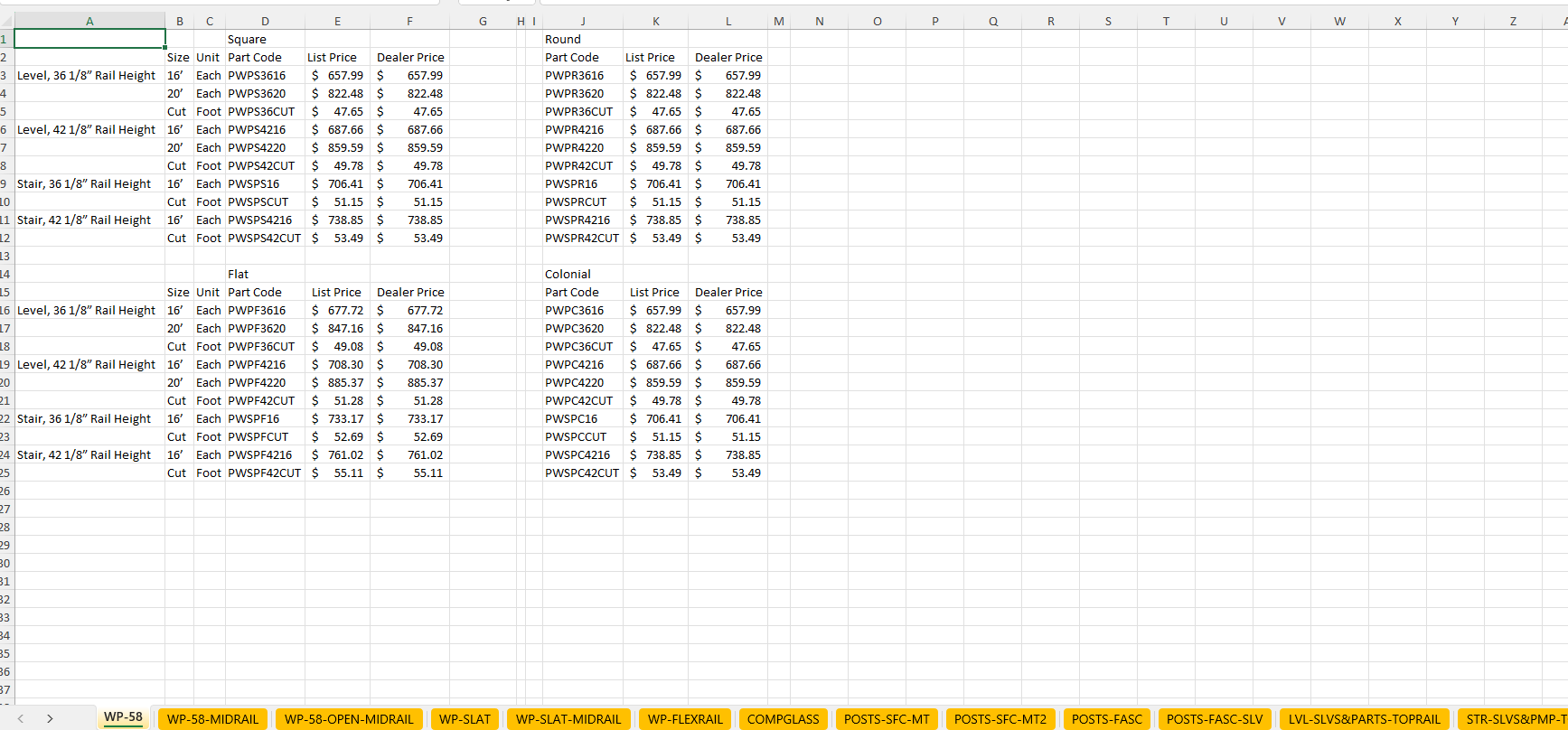
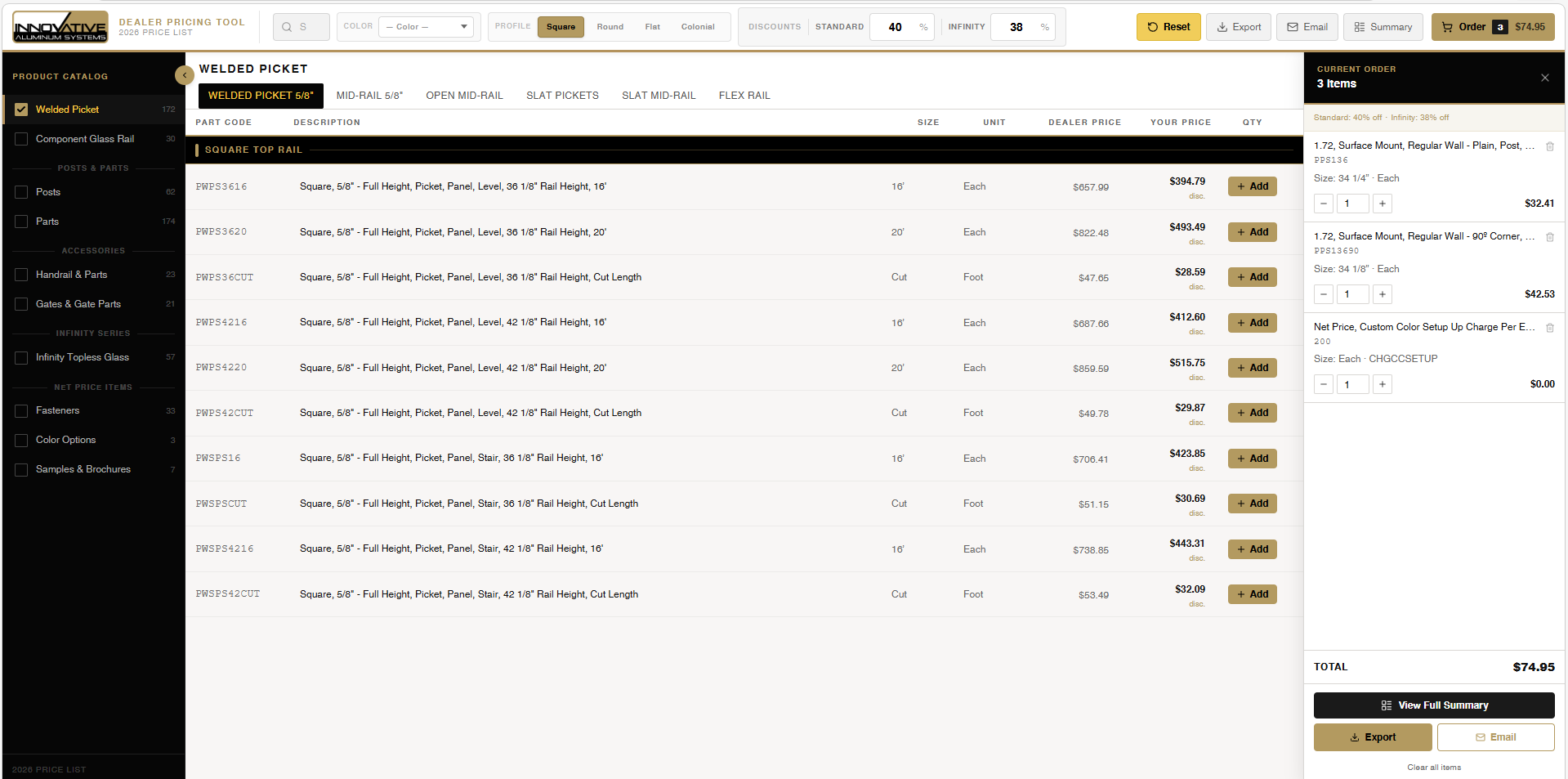
"We've been imagining something like this for years. Our catalog used to live in a spreadsheet we'd email back and forth — now our dealers can filter products, build orders in their own pricing, and send them through electronically. Mike built exactly what we needed."
Order forms: from printed sheet to guided system
Before — the customer order form was a printed Excel sheet with basic formulas. Sales reps filled it in by hand, calculated totals manually, and emailed or faxed it in. Error‑prone, slow, and entirely dependent on one person knowing where everything was.
After — a hosted web order form with multiple pricing tiers, a pattern selector with live unit pricing, cut‑length calculators, and a print‑ready summary. Orders are submitted electronically — no phone call, no fax, no manual calculation.
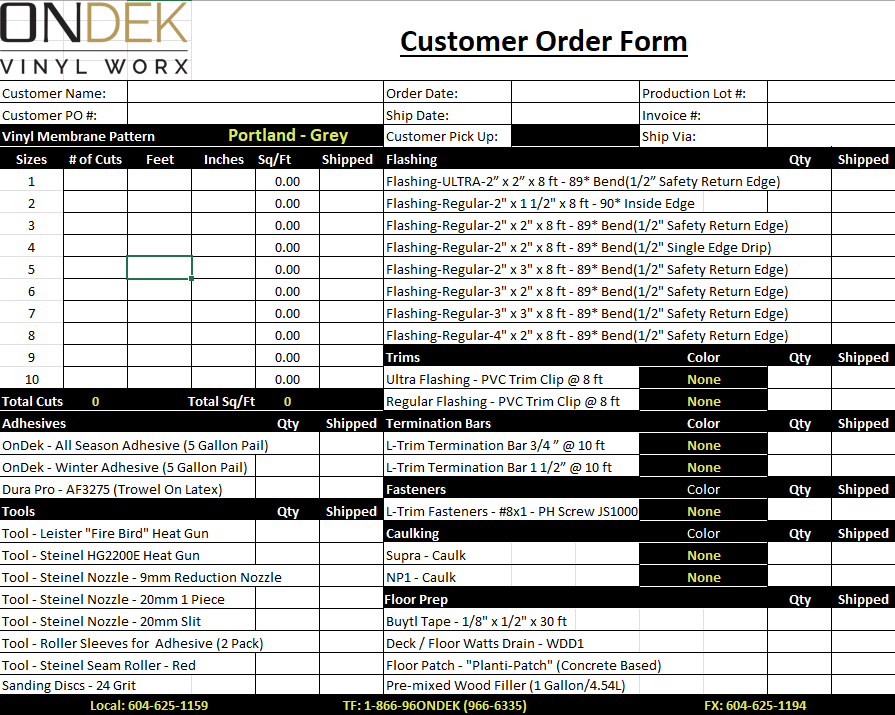
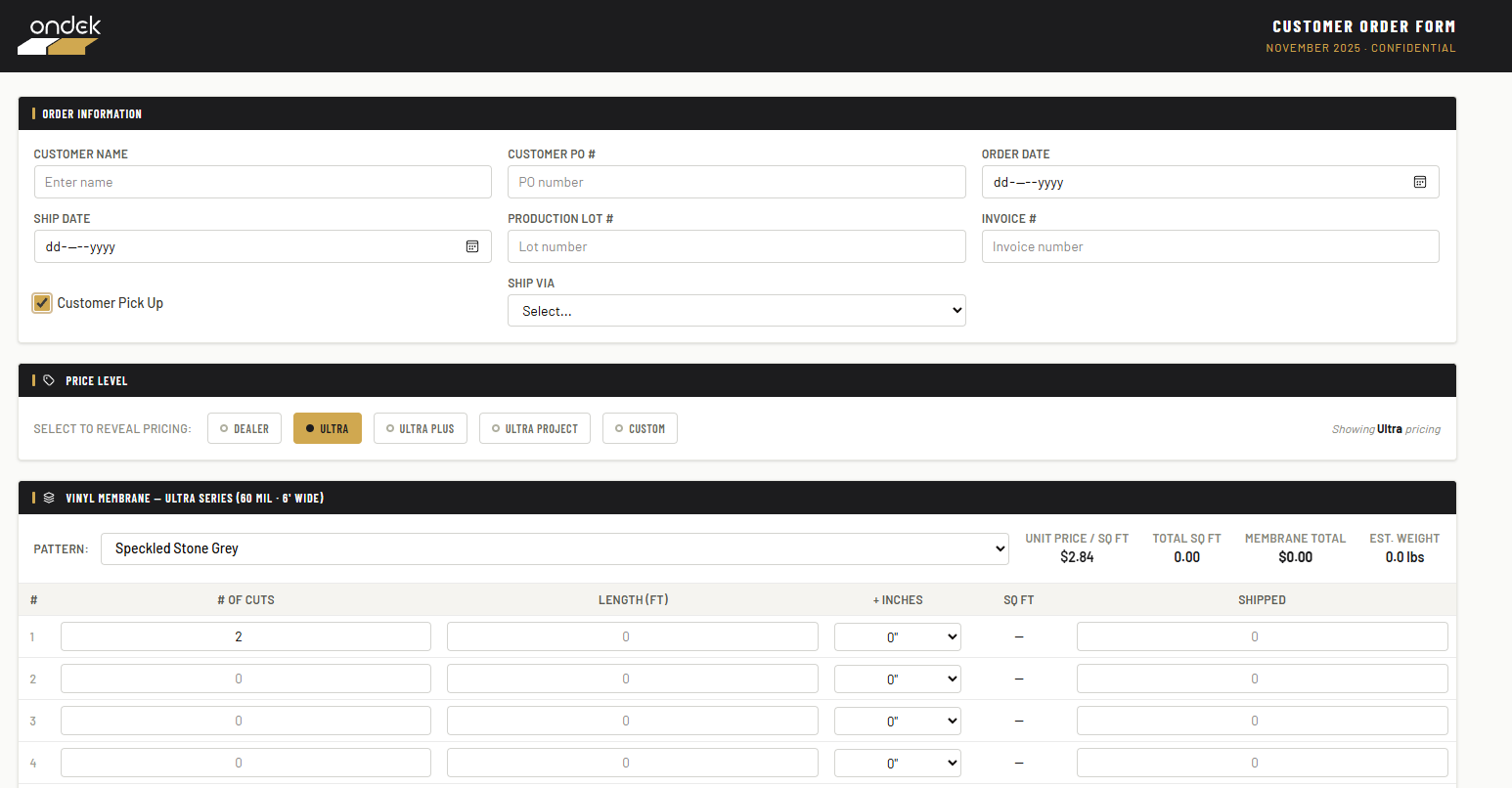
"I've been in this industry long enough to be skeptical of tech promises. This wasn't that. Michael took the time to understand our process first, then built something that fits. It's a massive leap forward for us."
Have a spreadsheet or a process that should work this way? Start with a conversation.
Why it's worth more
Captured know‑how isn't just safer. It's worth more.
When the person who knows how you really quote, price, and keep customers is the one closest to retirement, that knowledge is worth money — and right now it isn't written down, and it isn't yours to keep. We turn it into a cookbook the business owns — the documented DNA of how the place actually works — before it moves on with someone. Buyers, and the advisors who help owners sell, look for exactly this: documented, transferable know‑how is what turns a company that depends on one person into one that holds its value without them. A business that can hand the next owner the cookbook is worth more than one that hands over a login.
Could the office run through a month of your busy season without your most knowledgeable person? Buyers ask exactly that — and when the answer is “yes, it's captured, and it's ours,” your business is worth more.
The honest part
The hard part isn't the paperwork. It's people.
Most attempts at this quietly stall — and rarely because of the tools. BCG's research across hundreds of AI programs puts the recipe at 10% algorithms, 20% technology, and 70% people and process. The 70% is the part almost everyone skips. Most teams have already learned it the hard way: there's a binder somewhere — half‑finished, on a shelf, out of date the week it was printed. It didn't fail because the writing was bad. It failed because getting a veteran to hand over what they know, and getting a team to actually change how it works, is a people problem, not a paperwork one. Your best people aren't holding back to be difficult — they're protecting the thing that's made them irreplaceable for thirty years.
That human side is exactly what our sister practice, Open Communications →, is built for. Same business, same straight talk — one side builds the systems, the other works with the people.
How it works
Every step explained. Every decision yours.
No black boxes, no surprises — a transparent path from the first call to the final handoff.
-
A free fit call
A short conversation to see if there's a match. You describe what's slowing you down; we give you an honest read on whether we can help. No pitch, no obligation. If it's not a fit, we'll tell you and point you somewhere that is.
-
A paid discovery session
If there's a fit, a focused few hours working together where we map how work really moves through your business — who holds what, where the judgment sits, what would break first if someone left. You leave with a written map and recommendation, yours to keep whether or not we go further: the first rough table of contents of your cookbook. Fixed fee, agreed up front — and if a project follows, every dollar of it comes off the full cookbook.
-
Writing the cookbook
Once scope and price are agreed — written in plain language, before any work begins — we spend a day or so with the people who hold the know‑how, drilling into the recipes: how a quote really comes together, what gets checked before a job ships, the calls only experience knows how to make. The methods, the ingredients, the why behind each one. Then the cookbook is loaded into your AI tools, so the systems we build cook from the real thing — and quietly gather what changes between quarterly reviews. Scope changes along the way are a conversation, not a surprise invoice.
-
An asset you own — and grow
The work moves in short cycles with regular review, and what lands is yours: hosted, documented, owned. The first thing you notice is time — the systems take the repetitive work, and hours come back every week. Then the compounding starts: each quarterly review folds what changed into the cookbook, so the book gets richer, the systems get sharper, and the know‑how keeps accruing to the business instead of to any one person's head. Run it yourself, or keep us on call through System Care — a choice, never a requirement. Either way, you're not buying a tool that depreciates. You're building an asset that doesn't.
About
The person you'll actually be working with.
Michael Victory — ShopWisdom
I've spent 25 years inside small and mid‑sized businesses — including 13 building long‑term partnerships across a dealer network, and the last several years helping non‑technical people use modern tools well. I know what it looks like when good people are slowed down by tools that were never built for how they work — and what it costs a business when the person who knew how everything ran finally retires.
I started this practice because I kept seeing the same gap: the distance between what a business actually needs and what technology vendors were willing to build honestly and affordably. Most consultants either over‑engineer the solution or under‑explain the cost. I've been on the receiving end of both.
I use modern tools — including AI — to build faster and cheaper than traditional development, and I'll always tell you how something was built and what it can't do. No mystification, no inflated promises. And I'd rather tell you that you don't need me than sell you something you won't use — that judgment is what the discovery session is for, and the written recommendation is yours to keep either way.
Honest about fit
We're not for everyone.
ShopWisdom is probably not the right fit if you're:
- Looking to cut headcount through automation. AI used to make people redundant isn't what we do.
- Shopping for a black box to rent forever. You own the cookbook and everything we build from it — yours to take anytime. We'll keep it running and current if you want that (that's System Care), but it's a choice, never a leash. We don't do lock‑in.
- Shopping for a Super Bowl AI strategy or an AI pilot project. No hype, no transformation slides, no buzzwords — and no pilots that quietly die in IT. Just specific work with measurable outcomes.
- Facing people problems that run deeper than systems. Tools amplify what's already there. If trust is missing, software won't fix it — though that's exactly what our sister practice, Open Communications, takes on.
If any of that is you, we're probably not a fit — and being honest now saves us both time.
Start a conversation
Your know‑how built this business. Let's make sure it stays in it.
No pitch, no proposal until we've had a real conversation. Describe the friction — even roughly. The more context you share, the more useful our first call will be.
Prefer to reach out directly?
Email Michael Call 778‑985‑OPEN (6736)
The first call is free and commits you to nothing.